
Design and inference for line transect surveys in occupancy studies
Published:
Link to online draft can be found here. Target journal: Biometrics.
Abstract
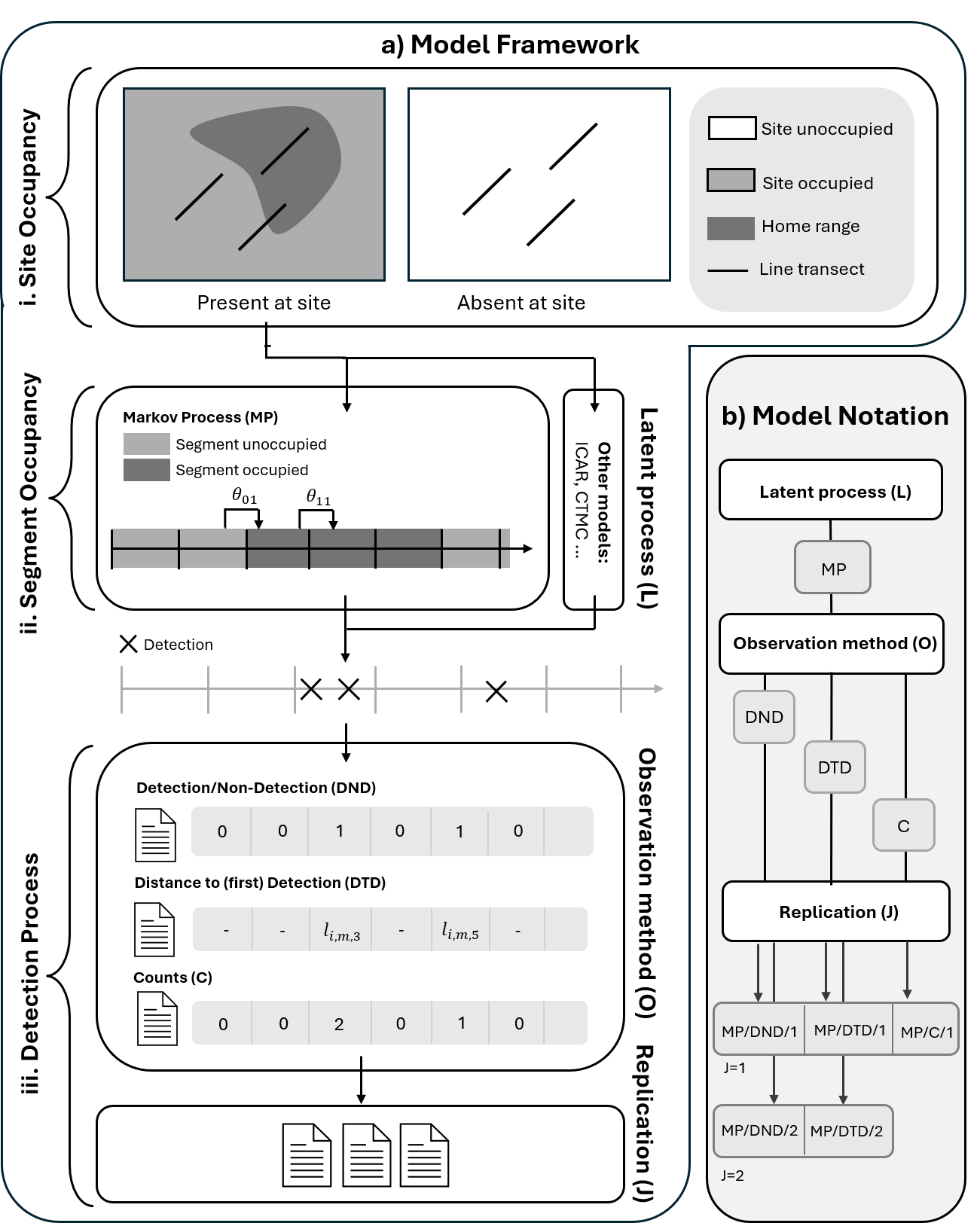
Line transect surveys, fixed paths along which observers record detections of animals or signs of their presence, are a core tool in ecological monitoring. In occupancy studies, line transect surveys are used to determine species’ presence/absence whilst accounting for imperfect detection and varying availability for detection along the transect. However, which research questions can be answered using such surveys depends on how detections are recorded, ranging from binary presence/absence in transect segments to continuous-time detections. These differing data collection protocols give rise to structurally distinct statistical models, with varying identifiability properties and inferential performance. In this paper, we present the first comprehensive comparison of commonly used line transect occupancy models within a unified framework, structured around data collection design, model formulation, parameter identifiability, and practical performance. Using algebraic analysis and data cloning, we show that widely used models are often either non-identifiable or not practically identifiable. We develop a novel, data-based diagnostic to detect this issue in applied settings. An extensive simulation study illustrates the practical implications of data-collection approaches, model choice, and corresponding inference. We make recommendations regarding choice of detection protocol and line transect survey design and demonstrate the real-world consequences of these findings using a case study on leopards in the Zambesi-Transfrontier Conservation Area in Central Africa. Our results offer methodological innovation and actionable guidance for ecologists and statisticians.
Code
Code available here.
Recommended citation: TBD
Download Paper