Line Transect data in Occupancy Studies: data collection methods and identifiability
Date:
In-person presentation for the 2024 summer International Statistical Ecology Conference (ISEC).
Abstract
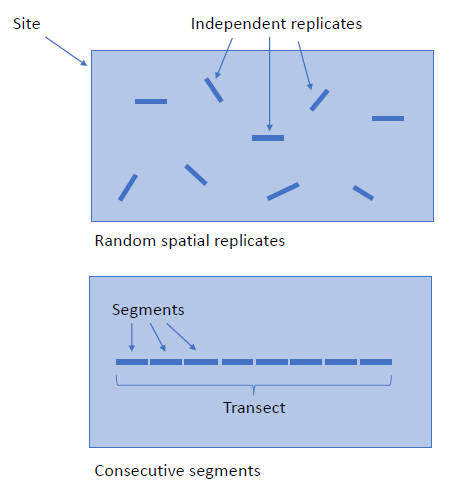
Spatial replication in occupancy studies may be used as an alternative to temporal replication. If a site does not permit independent spatial replicates, line transects divided into segments may serve as the replicates instead. An observer travels along the transect at each site and records a detection/non-detection at each of the segments. However, observations from consecutive segments are often not independent, as individuals may use (or partly use) established trails to travel, and so the correlation between segments needs to be accounted for. A common way of doing this is to introduce a Markovian dependence on segment occupancy, so that the probability a segment is occupied depends on the status of the previous segment. This model may produce unrealistic parameter estimates or fail to identify parameters relating to the detection and segment occupancy processes. We therefore investigate the identifiability of the model under a range of different model parameters. Through simulation, we compare different data collection methods to propose alternatives that prove identifiable when the method above is not. We consider both discrete (detection/non-detection) and continuous (distance to next detection) observations along with a varying number of detections made per segment (one, two, or all detections) to account for effort levels in data collection in practice.