More than presence-absence; modelling (e)DNA concentration across time and space from qPCR survey data
Date:
In-person presentation for the UKEOF UKDNA Working Group conference 2025.
Abstract
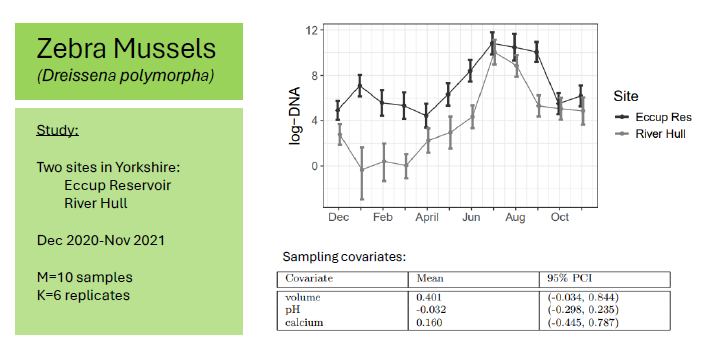
Environmental DNA (eDNA) surveys offer a revolutionary approach to species monitoring by detecting DNA traces left by organisms in environmental samples, such as water and soil. These surveys provide a cost-effective, non-invasive, and highly sensitive alternative to traditional methods that rely on direct observation of species, especially for protected or invasive species. Quantitative PCR (qPCR) is a technique used to amplify and quantify a targeted DNA molecule, making it a popular tool for monitoring focal species. Modelling of qPCR data has so far focused on inferring species presence/absence at surveyed sites. However, qPCR output is also informative regarding DNA concentration of the species in the sample, and hence, with the appropriate modelling approach, in the environment. We introduce a modelling framework that infers DNA concentration at surveyed sites across time and space, and as a function of covariates, from qPCR output. Our approach accounts for contamination and inhibition in lab analyses, addressing biases particularly notable at low DNA concentrations, and for the inherent stochasticity in the corresponding data. Additionally, we incorporate heteroscedasticity in qPCR output, recognizing the increased variance of qPCR data at lower DNA concentrations. We validate our model through a simulation study, comparing its performance against models that ignore contamination/inhibition and variance heterogeneity. Further, we apply the model to a case study involving aquatic species surveys in the UK. Our findings demonstrate improved accuracy and robustness in estimating DNA concentrations, offering a refined tool for ecological monitoring and conservation efforts.